


Cancer: the post-pandemic health crisis
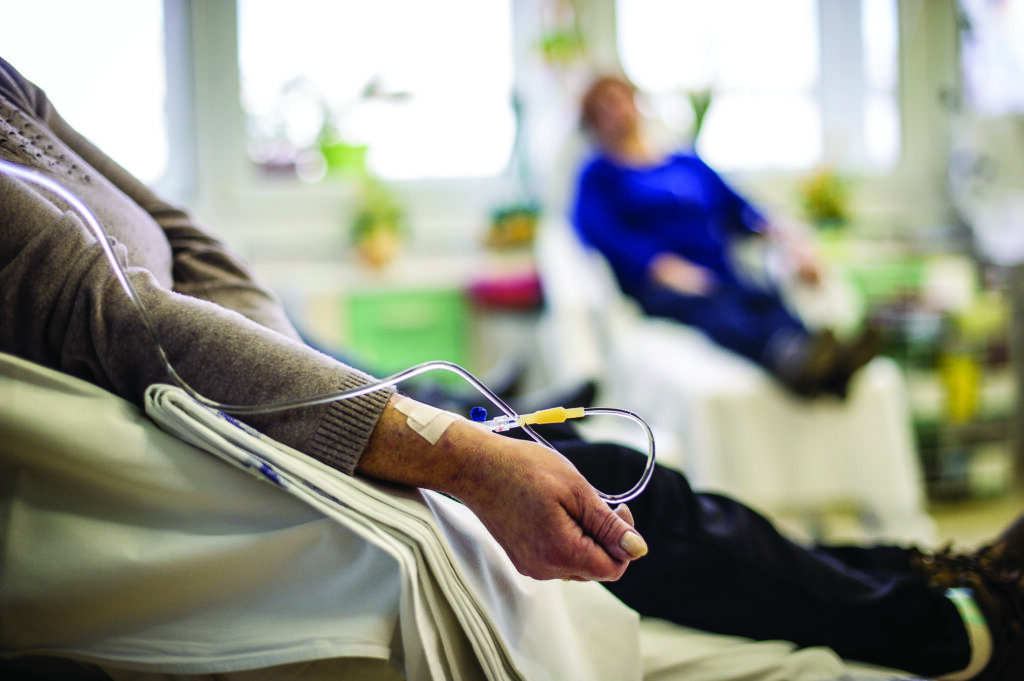
The facts are clear. Every day, winter and summer, a thousand people in Britain will be told they have cancer for the first time. That’s 30,000 a month; 360,000 a year. But at the time of the peak incidence of Covid, this dropped precipitously. Where did the missing patients go? How many are there? We know they exist, and their diagnosis was significantly delayed. Many will die consequently because of the delay. The excess deaths can only be counted accurately in at least one year’s time. Estimates vary from 30,000 to 60,000 lives lost.
Every policy has direct and indirect effects of intended and unintended consequences. Policies that require people to stay at home to reduce the morbidity and mortality from Covid will have effects way beyond the virus. They will adversely affect mental health and economic prospects for many. They will also affect people’s willingness and ability to access health and social services. This is likely to result in increases in morbidity and mortality from otherwise curable diseases, such as cancer, acute myocardial infarction (heart attacks) and stroke.
Despite the important impacts, most of the scientific evidence used to guide Covid policy in the UK has focused entirely on epidemiological models of the effects of Covid alone, and most notably the model formulated by Imperial College London. This was widely taken to be pivotal in the decision to go into lockdown. More recent models, such as the Scientific Advisory Group for Emergencies (SAGE) model immediately preceding the decision to go into a second national lockdown, do go beyond direct Covid mortality to consider the excess deaths from non-Covid causes in a scenario without extra measures. But these models still do not compare the morbidity and mortality that would result from other policy options. Cancer patients have been greatly disadvantaged by these policies.
How cancer presents
Cancer presents in a myriad of ways depending usually on the site of the primary tumour. Every part of the body can be affected, manifesting in a wide range of symptoms as diverse as headache, cough, chest pain, weight loss, abdominal discomfort, orifical bleeding and tiredness. Most patients with these symptoms do not have cancer – but it’s a massive sorting out exercise for the GP and hospital services.
We urgently need to restore cancer services to pre-pandemic levels.
The UK has been behind mainland Europe in cancer survival as long as this comparison has been available. It’s now clear that this is due to diagnostic delays. From 2000, patients with symptoms and signs likely to be due to cancer were triaged into a pathway whereby they were guaranteed to be seen by a relevant hospital consultant within two weeks. This did increase the speed of access to secondary care for some, but only 26 per cent of cancer patients came through this pathway. The majority remained in the traditional slow path, waiting months to see a consultant and then a further wait for key investigations such as CT scans, ultrasound, X-rays and endoscopy. Such delays did not happen in Europe where nearly all patients are fully investigated within two weeks. So, when Covid hit the UK, this under-capacity had a profound effect on increasing delays in diagnosis.
Treatment delays
The root causes of delay in cancer diagnosis and treatment due to Covid are fourfold:
- Patient delay in seeking help from GP or other health providers.
- Curtailment of primary care services making access difficult.
- Breakdown of hospital diagnostic pathways for cancer.
- Delays in starting the first cancer treatment – usually surgery.
At different phases of the pandemic, different factors assumed greater importance. Patient delay – essentially the bottling up of symptoms – were prominent at times of greatest lockdown. Fear was used deliberately by our government to enhance the stay home – protect the NHS – save lives message. Patients simply suppressed the progressive symptoms of early cancer.
There were clear difficulties in accessing primary care services. Even before Covid, GP appointments took some time to get and were essentially rationed. Patients with symptoms were used to waiting a month or more to see their GP and would often use other providers such as urgent care centres in hospitals or NHS 111. The lack of capacity within the system meant that once Covid caused additional workload, GP services in many areas simply crumbled.
The third point of delay was in the access to hospital diagnostic services. These are investigations that have to be performed within the hospital often as an outpatient procedure. The most common cancer related diagnostics include X-rays, CT scans, MR scans, ultrasound images, endoscopy and image guided biopsies. Ultimately the diagnosis of cancer requires a piece of tissue for histological examination making a biopsy or the excision of primary tumour mandatory.
The fourth cause of delay was access to operating theatres and anaesthetics at a time when even urgent surgery was suspended due to lack of staff. Surgery is the normal first line treatment for a wide range of solid tumours. For a few patients, alternative strategies were used at the height of the pandemic, but delays for most were inevitable as cancer surgery is nearly always an aerosol-generating procedure.
These delays inevitably caused upward stage migration in many patients, so reducing overall five-year survival significantly in many patients. As an example, a Stage 1 breast cancer patient has a 98 per cent chance of cure whereas a Stage 3 patient has only 25 per cent.
Similar prognostic figures apply to most solid tumours of which the four most common are breast, lung, prostate and colon. The timing of this upstaging is very variable and depends on both tumour and host factors. Delays in the diagnosis and treatment of cancer is the commonest cause for litigation. It is accepted that where there is breach of duty, a delay of six months or more is adequate proof of causation in claims for compensation.
The upstaging means that primary cancers usually confined to single organs are more likely to spread to lymph nodes and other structures. Effective treatment will therefore need complex surgery and require more medical intervention – chemotherapy, immunotherapy and radiotherapy to achieve optimal outcome.
As infection and mortality rates start to decline for a second time, the NHS has entered its third phase response to Covid-19. Continued vigilance is required to mitigate the risk of a further outbreak. Recently announced cancer metrics still demonstrated a significant reduction in the number of consultant referrals, and the number of new patients taking up radiotherapy and systemic anti-cancer therapies is still below normal. We urgently need to restore cancer services to pre-pandemic levels, to minimise the potential harm caused by the current disruption to services. Additional capacity is also needed to handle the backlog of patients.
Continuing issues
Even now, patients are still choosing not to present at their GPs due to a fear of exposure to infection. This will result in a delay of patients entering the system for diagnosis. They need to be assured that their concerns about symptoms should be acted upon and will be managed in a safe environment.
Diagnosis
The availability of, and attendance at, screening programmes has significantly slowed down. This will result in early indications of cancer being missed and the start of treatment delayed.
Surgery
Most urgent cancer surgery has continued, albeit at reduced levels. The NHS cancer hubs are providing Covid free hubs to increase the throughput of patients, but there is already a backlog to address. It is inevitable that within the five million people currently on an NHS waiting list, there will be patients with so far undiagnosed cancer.
Treatment
Some cancer treatments have continued throughout. However, as some patients were at greater risk of Covid than starting treatment, and the patients not yet referred or diagnosed, there is a significant backlog to address and a surge in demand is anticipated for later this year.
Post-treatment services
Some patients will require on-going support, and the NHS is already anticipating additional pressure on primary and community care following discharge from treatment.
Workforce
The NHS workforce has been depleted during the pandemic through staff being ill or self- isolating with symptomatic family members. This is likely to continue and directly affect the NHS’s ability to recover levels of service. The NHS recognises that staff are exhausted and stressed, which may also impact the pace of service recovery.
Independent sector (IS)
Just as the IS was an integral part of the bed-capacity requirements for phase 1 of the pandemic, it has a critical role to play in the restoration of cancer services. Figure 2 shows the IS centres across the UK that provide cancer services. Rutherford Health’s analysis of this capacity and its availability to the NHS is as follows:
1. Surgery and diagnostics
The 19 currently operational cancer hubs partially involve private-sector hospitals for surgery and diagnostic biopsies. Most of this phase of activity was transferred back to Covid Free Zones (CFZs) within NHS hospitals by October 2020.
2. Conventional radiotherapy
There are 26 private linear accelerators (LINACs) currently staffed and operational. These are in addition to NHS LINACs used part time for private patients. The capacity of each LINAC is 1,200 patients a year. The private sector therefore has the potential capacity to treat 31,200 new radiotherapy patients annually.
3. Precision radiotherapy
Radiotherapy can be used as an alternative to surgery in certain circumstances. Lung, pancreatic and prostate cancer are obvious targets for this substitution. Three precision techniques are available in the independent sector:
(i) Stereotactic ablative radiotherapy (SABR)
Low fraction number, high-dose precision treatments are regularly used for lung and other cancers. Increasing their availability by harnessing the IS will dramatically enhance overall capacity. The majority of modern LINACs can easily be adapted for SABR once the appropriate software is loaded. Local collaboration to create SABR outposts of NHS centres can be developed within days.
(ii) MR LINACs
There are now four active MR LINACs in the UK – 2 NHS and 2 IS. This precise form of image-guided radiotherapy could be used for selected patients with Stage I and II localised cancers.
(iii) Proton beam therapy (PBT)
There are now four active PBT centres – The Christie, Manchester (NHS) and the Rutherford Centres in Newport South Wales, Reading and Northumbria. Three more are scheduled to come on stream shortly – UCLH, London (NHS); Liverpool (Rutherford) and Harley St, London (Advanced Oncotherapy). Where appropriate, the existing NHS Standard Operating Procedure for handling referrals could be amended to include the IS Centres to improve access to this service. The Rutherford Cancer Centres currently have capacity for up to 750 new patients per year.
The Covid trade-off
Comparing the various outcomes of different policy options requires a common metric. Over the past few decades, there has been considerable debate about whether mortality risks should be valued according to the number of life-years saved rather than the total number of lives. An important goal of policy is to generate as much benefit as possible for as long as possible, and so a life-years approach seems preferable in this regard, since lives are never saved but merely prolonged. Considering life-years rather than lives is more commonplace in the appraisal of healthcare intervention, where the UK has been at the forefront of the adoption of quality-adjusted life-years (QALYs). QALYs seek to combine the value of changes in quality of life and length of life into a single number, where one year of life in full health is equivalent to one QALY.
The debate around how to measure benefits, and especially lives versus life-years, is crucial in the case of Covid as mortality risks are highly correlated with age and underlying health issues, and hence strongly negatively associated with remaining life-years. According to the ONS, the average life expectancy of deaths associated with Covid (unadjusted for the effect of underlying conditions) was estimated to be 10.5. Some have suggested that adjusting the years of life lost (YLL) from Covid for the number and type of long-term conditions typical of Covid deaths only results in a decrease in YLL of around 10%.
In contrast, excess non-Covid deaths from treatable illnesses, such as cancer, will result in a much higher average number of years-of-life lost. A six-month delay in patient presentation and diagnosis for cancer has been estimated to lead to 9,280 lives and 173,540 life-years lost, implying an average life expectancy of around 19 years.
Despite the relevance of age and years of life lost, most Covid discussions have focused on lives rather than life-years. A study by the Department of Health and Social Care (DHSC) did find that the QALY losses from lockdown exceeded the QALY losses from direct Covid-19, but this study did not gain nearly as much traction as others taking a lives-saved approach.
Life-years lost
Estimates from Cancer Research UK showed that around three million people missed their cancer diagnostics during the UK lockdown. A recent systemic review and meta-analysis showed that as little as a four-week delay was associated with an increased mortality for seven cancer types. It therefore becomes important to consider the life-years saved from the Covid deaths prevented by the UK lockdown to the life-years lost from excess cancer deaths. Note that cancer deaths represent only one, albeit important, indirect effect of lockdown measures.
Figure 1: Required number of Covid deaths prevented (as a function of average Covid life-years saved) for total Covid life-years saved to equal total life-years lost from excess cancer deaths.
For example, in the case of a six-month delay in cancer diagnoses, if the average life-years saved from averted Covid deaths is four, more than 43,385 Covid deaths need to have been prevented for the UK lockdown to be the correct policy choice in terms of a maximisation of life-years saved.
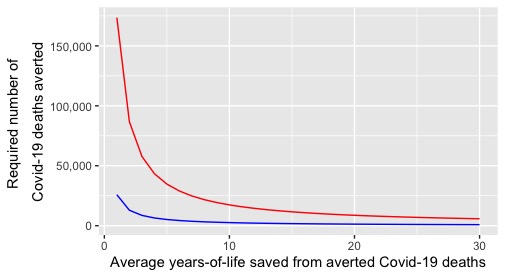
Blue line: three-month delay in cancer diagnosis
Red line: six-month delay in cancer diagnosis
Average years-of-life saved from averted Covid deaths could be over 30; x-axis cut for readability
The ripple effect
A comparison between the life-years saved from the Covid deaths prevented during the UK lockdown and the life-years that will be lost in the near future from excess cancer deaths due to lockdown indicates that preventing Covid deaths through lockdowns might result in more life-years being lost than saved. For example, if the average life-years saved from prevented Covid deaths is eight and lockdown produced six months of cancer delays, anything less than around 22,000 Covid deaths prevented would mean more life-years lost to cancer than saved from Covid.
Of course, many epidemiological models have put forward very high Covid death estimates from no-lockdown scenarios that would cause the Covid life-years saved to far exceed the life-years lost to cancer. For example, Imperial College estimated that a no-lockdown scenario would lead to 500,000 Covid deaths, which would require more than 210,000 cancer deaths for cancer deaths to be prioritized in a life-years approach (if the average life-years saved from prevented Covid deaths is eight).
However, the credibility of these high Covid death projections has been questioned. Furthermore, cancer deaths represent only one, albeit important, indirect effect of lockdown measures. Policies to deal with Covid affect mortality risks from many other conditions, such as stroke and myocardial infarction; it is possible that preventing Covid deaths through lockdowns might result in more life-years being lost than saved. We need to capture all the ripple effects of any policy and not just the initial splash when the pebble of intervention hits the water.
Karol Sikora
Professor of Cancer Medicine
Professor Karol Sikora is Chief Medical Officer of Rutherford Health. He was the founder of Cancer Partners UK which has created UK’s largest independent UK cancer network with private equity. He was Professor and Chairman of the Department of Cancer Medicine at Imperial College School of Medicine and is still honorary Consultant Oncologist at Hammersmith Hospital, London. He was seconded to be Director of the WHO Cancer Programme in 2000.
He was the Founding Dean and now Professor of Medicine at Britain’s first independent Medical School at the University of Buckingham and a Fellow of Corpus Christi College, Cambridge. He has published over 300 papers and written or edited 20 books including Treatment of Cancer – the standard British postgraduate textbook, now in its seventh edition in over 30 years. His book, The street-wise patients guide to surviving cancer was published recently.
A year ago, he joined Twitter and now has over three hundred thousand followers. During the Covid crisis he has been dubbed the Positive Professor.
Follow Karol on Twitter: @ProfKarolSikora


