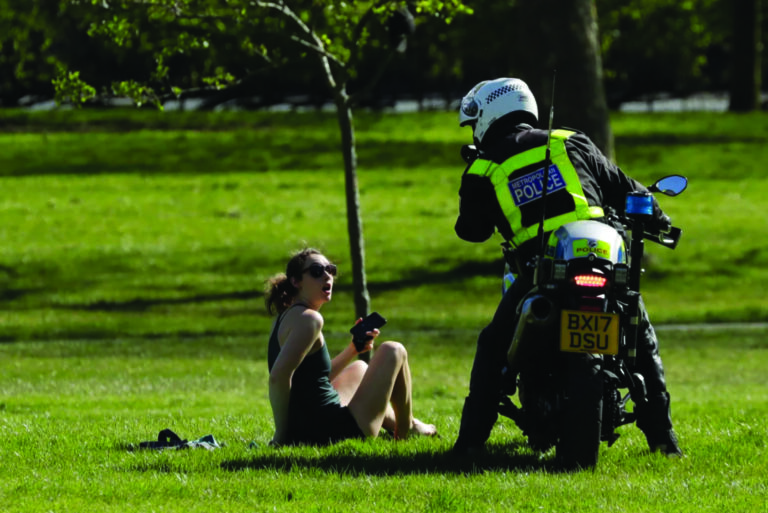
Free speech: a lockdown on disagreeing

On 3 April 2020, I wrote an article for the Telegraph about the tsunami of criticism I’d received after publishing a sceptical piece at the end of March about the UK government’s lockdown strategy.
That piece appeared in The Critic and shortly after it was published I started trending on Twitter, with thousands of people denouncing me, often using intemperate language. In the Telegraph article, I expressed my disappointment about this reaction and said people shouldn’t feel shy about criticising the lockdown even if those views put them at odds with the government and its medical advisers, as well as a majority of the electorate. Our leaders were making decisions every day that would affect all of our lives for years to come and it was right to scrutinise those decisions in the public square.
In the days that followed the Telegraph article, I was contacted by dozens of people, many of them doctors and scientists, who shared my reservations about the lockdown policy and were frustrated that it wasn’t being properly challenged. Some had tried to get their views published in newspapers, either as letters or articles, but without success. That’s when I decided to create a blog called Lockdown Sceptics. The idea was for it to serve as a hub for sceptical articles, academic papers and interviews that had appeared elsewhere, as well as to provide an opportunity for experts and non-experts to air views that they couldn’t get published anywhere else.
From the start, I also welcomed rebuttals of these views. The critical thing, I believed, was to have an informed public debate. Decisions of this importance, affecting the UK’s entire population, shouldn’t be ‘left to the experts’, as some people believed – and I was astonished by how many people condemned me and other sceptics on the grounds that we lacked the scientific expertise to evaluate the government’s handling of the pandemic, or the advice it was receiving from the Scientific Advisory Group for Emergencies (Sage). To invoke David Hume’s famous distinction, scientific knowledge can tell you what is; it cannot tell you what you ought to do.
Abusing critics
Most contributors to Lockdown Sceptics were small ‘c’ conservatives like me because we place a high value on those freedoms protected by English Common Law. We were horrified by the suspension of those liberties because we worry about the cost of wide-scale state interventions, as well as their unintended consequences, and… well, because scepticism is at the core of our political philosophy.
But I received plenty of emails from people with very different political values to mine, including some lifelong socialists. These emails usually began: ‘I’ve never agreed with anything you’ve ever said before, but on this issue…’ I loved getting those emails because it showed people were willing to set aside party political differences in order to have an informed debate about the lockdown policy. As Pericles, the prime minister’s political lode star, said: ‘Instead of looking on discussion as a stumbling-block in the way of action, we think it an indispensable preliminary to any wise action at all.’
But that democratic ideal was hard to hold onto as the debate over the lockdown policy became more polarised. When I came up with the phrase ‘lockdown sceptics’ to describe those who were critical of the lockdown policy, I didn’t anticipate that it would enter the political lexicon or be used by many as a term of abuse.
The economist Sam Bowman, with whom I’d had a relatively civilised debate at the beginning of the crisis, went on to join forces with the Conservative MP Neil O’Brien and set up a website called Anti-Virus: The Covid-19 FAQ devoted to attacking lockdown sceptics, including the medical scientists Sunetra Gupta, Karol Sikora and Carl Heneghan. He and others homed in on some of the inaccurate predictions made by sceptics – claiming Britain was approaching herd immunity in the summer of 2020, for instance – and cited those as proof that we were wrong about everything else.
But, of course, supporters of the lockdown policy have made just as many inaccurate predictions – the Warwick University modelling team predicted in May of last year that daily Covid deaths would climb to above 4,000 a day in the summer of 2020 if we lifted controls too quickly – and it seems unfair for our opponents to hold us to a standard they don’t hold themselves to. When you’re debating how best to respond to something as fast-moving and unpredictable as SARS-CoV-2, with so many variables affecting the rise and fall of infections, it’s inevitable that all sides are going to get some things wrong. I don’t think the sceptics’ track record was any worse than that of our opponents. In fact, I think it was a good deal better! (You can see a selection of research studies showing that lockdowns are largely ineffective on the American Institute for Economic Research’s website, although the best argument is that Sweden experienced a smaller increase in its overall mortality rate in 2020 than a majority of European countries, in spite of eschewing the lockdown policy.)
Absent opposition
It often felt to those on my side of the debate that we weren’t competing on a level playing field. I don’t just mean that the lockdown’s defenders were less inhibited about launching ad hominem attacks, although that was certainly true. When Sunetra Gupta joined forces with Jay Bhattacharya and Martin Kulldorff to launch the Great Barrington Declaration on 4 October 2020, proposing an alternative to the lockdown strategy, they were accused by three public health scientists in the Guardian of being under the influence of right-wing billionaires who were trying to give scientific legitimacy to a ‘neoliberal’ agenda. Another tactic favoured by our opponents was to label us ‘Covid sceptics’ (see the Anti-Virus website mentioned above), although I don’t think any of the prominent lockdown sceptics have ever denied that Covid-19 is a serious disease that poses a mortal danger to those in poor health.
Nor do I mean that the pro-lockdown side had the spending power of the British state at its disposal, although that was true, too. Normal rules about the amount of money the government is allowed to spend on promoting its point of view were suspended during the crisis because the pro-lockdown messaging was designed to secure compliance with its social distancing guidance, and that would supposedly ‘save lives’. Had the government spent taxpayers’ money on ads that made the case for its suppression strategy, rather than a less draconian approach, that might have been more controversial, particularly if the Labour Party had been in favour of the latter.
Science can tell you what is. It cannot tell you what you ought to do.
But the paid-for messaging took it for granted that the government had broadly adopted the right strategy – as did the leader of the opposition – and instead, focused on what people should do to help facilitate it. So, the Conservative Government was allowed to get away with spending hundreds of millions of pounds on an advertising campaign that, indirectly, affirmed the wisdom of Boris Johnson’s approach. Incidentally, a good deal of this money was spent on full-page newspaper ads, giving the print media a much-needed financial boost when its other advertising revenue had declined and thereby creating a powerful incentive for editors to support the government. Little wonder that 13 months after the first lockdown was imposed, in spite of the huge collateral damage caused by the policy, the Conservatives were clocking up 14-point leads in the polls.
Using the same rationale – the lockdown was essential to save lives – the government gave itself permission to use covert psychological strategies, with the help of its Behavioural Insights Team, to ratchet up fear of the virus among the British population. That, too, was justified on the grounds that it would increase compliance with social-distancing measures but, like the advertising campaign, it had the indirect effect of convincing people that the lockdowns were necessary. After all, if the threat posed by Covid-19 had been properly contextualised – compared to the threat posed by the other major causes of death, for instance – people might have been less willing to accept what Lord Sumption called the greatest interference in personal liberty in Britain’s history. Again, not a squeak from Keir Starmer. A democratic government was allowed to get away with using sophisticated propaganda techniques to secure people’s consent for the suspension of their rights, something that could never have happened in ‘peacetime’.
Media consensus
Just as sinister was the Government’s enlistment of Ofcom, the state broadcasting regulator, to ensure any dissent from lockdown orthodoxy was kept to a minimum on the airwaves. On 23 March 2020, the same day the first lockdown was announced, Ofcom issued a ‘Note to Broadcasters’, reminding them of the ‘significant potential harm’ that could be caused by dubious health claims about the virus or inaccurate or misleading programmes ‘in relation to the virus or public policy regarding it’.
On 20 April, Ofcom followed up by reprimanding Eamonn Holmes, a television presenter, for having said something that ‘could have undermined people’s trust in the views being expressed by the authorities on the Coronavirus and the advice of mainstream sources of public health information’. Holmes’s sin, according to Ofcom, was to say on ITV’s This Morning on 13 April that any theory running counter to the official Covid narrative – such as the one linking 5G masts and the symptoms of Covid-19 – deserved to be discussed in the mainstream media, if only so it could be thoroughly debunked. This was in spite of him saying the 5G conspiracy theory was ‘not true and incredibly stupid’. Ofcom said this view – the view that such theories deserved a public hearing, not that they were in any way plausible – was ‘ill-judged and risked undermining viewers’ trust in advice from public authorities and scientific evidence’.
The Free Speech Union, of which I’m the CEO, applied to the High Court for permission to judicially review this guidance, but we were unsuccessful. Our argument was that by warning broadcasters not to air anything that could undermine people’s trust in the advice being issued by the authorities about the virus, Ofcom was inhibiting them from giving a platform to people who were critical of the government’s overall approach. After all, if you appear on television and say lockdown is causing more harm than good, that could have the effect of undermining people’s confidence in the social-distancing advice being disseminated by the Department of Health.
The judge didn’t accept this. Like most educated professionals, he didn’t regard the lockdown as a politically contentious intervention, but, rather, an unavoidable policy dictated by ‘the science’ that any responsible government would implement, as nearly all Western governments did. For him, it went without saying that anyone challenging the authorities’ social-distancing advice, including the insistence that you should not leave your home without a ‘reasonable excuse’, was potentially causing harm.
In fairness to the judge, he did invite us to produce evidence that broadcasters were actively suppressing criticism of the Government as a result of Ofcom’s guidance and that proved hard to do. The evidence I came across wasn’t the kind that would stack up in court.
For instance, on 14 October 2020, Sunetra Gupta appeared on BBC News to talk about the new control measures that had been introduced in the north of England and just before she went on air one of the producers told her not to mention the Great Barrington Declaration. Naturally, she ignored this instruction, but where did it come from?
Otherwise-liberal people embraced censorship and no-platforming to promote their cause.
Another example: at the end of September 2020, Professor Susan Michie, a member of Sage, took to Twitter to complain that she’d been invited on to the Today programme to discuss the lockdown on the understanding that the scientists who opposed it would be portrayed as beyond the pale, only for Professor Gupta to make a compelling, logical argument. ‘I’d got prior agreement from R4 about the framing of the item’, she wrote. ‘I was assured that this would not be held as an even-handed debate.’ On whose authority had she been given that assurance? We couldn’t prove it had been handed down from some high-up at the BBC who was worried about being censured by Ofcom.
In truth, I doubt that Ofcom’s coronavirus guidance was a major cause of the one-sidedness of the debate about lockdown on the airwaves. A consensus quickly developed among broadcast journalists, as well as broadsheet journalists, that the first lockdown was necessary – and they were broadly supportive of the second and third lockdowns, too. Insofar as they were critical of the government’s handling of the crisis, it was generally for not locking down sooner or more severely or for longer. There were exceptions – the Mail and the Telegraph were the most sceptical of the national newspapers, although not unequivocally so, and the occasional sceptical voice slipped past the BBC’s bookers, notably Lord Sumption. But the only media platforms that took up a broadly sceptical position were those on the fringes of the mainstream media, such as talkRADIO, the Critic and the Conservative Woman. It was in this not-quite-respectable ecosystem that Lockdown Sceptics was located.
Social media
This consensus extended far beyond journalism and encompassed nearly all the elite professions across the developed world, including the managers of the big social media platforms who diligently censored anyone who dissented from the positions taken by the World Health Organisation (WHO) – including talkRADIO – even though those positions sometimes shifted. When Dr David Nabarro, the WHO’s special envoy on Covid-19, told Andrew Neil on Spectator TV on 9 October 2020 that ‘we in the World Health Organization do not advocate lockdowns as the primary means of control of this virus’, I joked with other sceptics that YouTube would now have to review its content over the previous six months, restore all those videos it had taken down because they were critical of the lockdown policy and remove those that were in favour. But, of course, it didn’t happen.
I had my own run-in with YouTube when it removed a clip I’d posted on my own channel for ‘violating’ its ‘community standards’. This was a discussion in which I’d made the civil-rights argument against indiscriminately quarantining whole populations. The clip was restored when I pointed out that the other person in the discussion, nodding his head enthusiastically as I railed against the government, was Michael Levitt, joint winner of the 2014 Nobel Prize for Chemistry. Levitt himself was later disinvited from a conference on computational biology and biodesign, even though those fields wouldn’t exist without his work.
Moral righteousness
It was this consensus in favour of the lockdown policy, and the hostility of its adherents to anyone who dissented from it, that was the main reason it was so hard to have a proper public debate. One of the most striking characteristics of the policy’s enthusiasts was their moral righteousness, which was why otherwise-liberal people were happy to embrace illiberal strategies, such as censorship and no-platforming, to promote their cause. Such cancellation strategies are commonplace at either end of the political divide – particularly on the woke left – but the unusual thing about the pandemic period was that they were used by people who define themselves as moderates and centrists.
Was this because they were convinced that lockdowns saved lives and therefore anyone who criticised them posed a danger to public health? They often spoke as if they believed that, and a team of researchers published a paper in the Journal of Experimental Social Psychology in March 2021 showing that the efforts of governments and their scientific advisors to control the pandemic had become moralised, with anyone questioning those efforts being treated with the same moral disgust as someone who questioned sacred values. A good example of this was the journalist Dominic Lawson, who wrote an article in The Sunday Times accusing Sunetra Gupta and me of causing the deaths of people who’d caught Covid-19 after we’d misled them about the seriousness of the UK’s epidemic.
Such puritanical zeal was rarely exhibited by the sceptics, which on the face of it is odd. After all, most of us are convinced that the lockdowns killed many more people than they saved and we could just as easily have accused our opponents of having blood on their hands. But we didn’t – at least, most of us didn’t. On the contrary, we shied away from arousing people’s moral indignation as a way of persuading them to embrace our cause, preferring to cite the empirical evidence. That may be one reason why we lost the argument: while we were pointing to the paucity of data about the positive impact of lockdowns on infections, hospitalisations and deaths, as well as the evidence that they were causing social and economic harm, our opponents were going puce with rage and screaming: ‘Blood on their hands.’
Status signalling
So why did the educated bourgeoisie across the Western world become such fanatical lockdown adherents? No doubt social psychologists will be debating that puzzle for decades. My theory is it wasn’t about virtue signalling so much as status signalling, although the two nearly always go together. The key thing is that at an early stage in the evolution of the pandemic a consensus emerged among public-health scientists that the best way to mitigate its impact was to quarantine everyone in their homes, the healthy as well as the sick. Why this happened is hard to say, given that the lockdown policy was historically unprecedented and, up until 2020, public-health authorities, including the WHO, had advised against quarantining in the event of another pandemic.
I expect it had something to do with the apparent success of the lockdown in Wuhan, the television pictures from Bergamo on the nightly news in March 2020 and the WHO’s recommendation that other countries should follow China’s example if they wanted to avoid a similar catastrophe. And, let’s face it, it doesn’t take much to persuade liberal policy makers that the best solution to any crisis is a large-scale state intervention, something I wrote about in the Critic.
But whatever the reason, once the view got abroad that ‘the science’ was four square behind the lockdown policy, the world’s educated elites, including the international political class, fell into line. This wasn’t because they trusted the judgment of public health panjandrums like Tedros Adhanom, Anthony Fauci and Bill Gates, although that played a part. It was more because disagreeing with them is a low status indicator. In the eyes of the West’s elites, those expressing scepticism about the wisdom of the lockdown policy were indistinguishable from anti-vaxxers and the people vandalising 5G masts. They were ‘conspiracy theorists’, which has become a synonym for uneducated, knuckle-dragging troglodytes – the kind of people who stormed the Capital building in January 2020 to ‘stop the steal’. And it didn’t help that those political leaders who rejected the pro-lockdown consensus – Donald Trump, Marine Le Pen, Jair Bolsonaro – were untouchables as far ‘Davos Man’ was concerned. For the global elite, and their bag carriers in the professions, supporting lockdown was just something that everybody did, like turning left on an aeroplane and spending Christmas in the Caribbean. It was a no-brainer.
That’s my theory about why the world went to hell in a handcart in March 2020 – or, rather, a Mercedes-Maybach S 650 Pullman. It wasn’t state censorship or Silicon Valley censorship or the resources devoted to promoting compliance with the lockdown policy by governments around the world, including psyops, that quietened dissenting voices during the crisis. Rather, it was self-censorship by the chattering classes prompted in the main by them not wanting to appear scientifically illiterate. The armies of commentators and behind-the-scenes influencers who would normally be picking quarrels with each other and scrutinising every detail of government policy became nodding dogs for a year.
The counter-narrative platform I created was more of a jalopy, but one into which thousands of sceptics crowded, like a group of students trying to secure a place in the Guinness Book of Records by squeezing into a Mini. At its peak, Lockdown Sceptics averaged 1.25 million page views a month – not bad for a website housed in my garden shed and held together with the digital equivalent of Sellotape and rubber bands. Our slogan was: ‘Stay sceptical. Control the hysteria. Save lives.’ But maybe it should have been: ‘Proud to be a deplorable.
Toby Young
journalist, general secretary of the Free Speech Union
Toby Young is the general secretary of the Free Speech Union and the editor of LockdownSceptics.org. He is the author of four books, the best known of which is How to Lose Friends & Alienate People (2001), and three plays, including Who’s The Daddy? which was named Best New Comedy at the 2006 Theatregoers’ Choice Awards. His teaching experience includes working as a teaching fellow at Harvard and a teaching assistant at Cambridge. He was an energetic participant in the Vote Leave campaign and is an associate editor of the Spectator, where he has been a weekly columnist for 21 years, an associate editor of Quillette and an associate editor of The Critic.
Follow Toby on Twitter: @toadmeister
More voices on Freedom