Lockdown and the law: a bonfire of civil liberties
The government response to Covid-19 has been to introduce the most draconian curtailment of civil liberties since the Second World War. On 26 March 2020, the Coronavirus Act 2020 passed through Parliament in just four sitting days, and the Health Protection (Coronavirus Restrictions) (England) Regulations 2020/350 came into force under the Emergency Procedure of the Public Health Act (part 2A, section 45R) without going through Parliament.
It is these Health Protection Regulations that introduced the powers restricting movement, work, business, worship and gatherings. In summary, they criminalise normal social behaviour and are in force through ministerial fiat. Devolved governments also meant that different emergency type laws applied to Scotland, Northern Ireland, Wales and England. I will focus upon England, but similar considerations apply to the other nations.
Law and guidance
The Health Protection Regulations have been relaxed, heightened, expanded and reduced; accompanied by overriding bafflement. A pattern developed. Each new set of amendments would be published the night before they came into force. On one occasion, there was only a 15-minute gap between publication and coming into force, difficult even for lawyers to properly understand. Guidance and ministerial pronouncements in anticipation of the amended Regulations would be made the preceding week. However, the guidance usually was more restrictive than the law[1] and the ministerial pronouncements mixed up law and guidance. This has been consistently compounded by government conflation of both law and guidance into ‘rules’.
While not quite in the league of Caligula who ‘wrote his laws in a very small character, and hung them up upon high pillars, the more effectually to ensnare the people’, there has been absolute confusion by ministers, prime minister, police and members of the public as to the law in force.
At the time of writing, there have been 71 pieces of Covid related Regulations and 26 versions of Health Protection Regulations (England). Law must be accessible and clear to people otherwise the law itself is not lawful. Yet the coronavirus laws repeatedly lack legal certainty.
Communal worship
Further, there has been no or little parliamentary scrutiny of how the science informed the restrictions. For example, up until 4 July 2020 there was a ban on communal worship. The effect of the Regulations up until that time was that it was lawful for a member of the public to visit garden centres, golf clubs or house-viewings in private homes, but not for a person to arrange for socially distanced communal prayers in a mosque (even with restricted numbers).
I represented Tabassum Hussain, the chair of the executive committee of the Jamiyat Tabligh-ul-Islam Mosque, in Bradford. He challenged the government ban, seeking to open restricted Friday Jummah prayers with limited numbers and social distancing and other public-health measures. Permission was granted for the case to be argued, but it bounced into the long grass as restrictions eased, enabling the government to respond that it was academic – the fact that a ban had occurred at all was to be forgotten.
And yet the freedom to manifest a religion (Article 9 of the European Convention on Human Rights) is, according to the judgment in one human rights case, one of the ‘foundations of a “democratic society”… the pluralism indissociable from a democratic society, which has been dearly won over the centuries, depends on it”[2]. There was no science relied upon to blanket ban carefully curated communal worship. When the government’s evidence came much later (in another case, concerning a different religion) it was in the form of a SAGE paper of 21 September 2020 and a SAGE summary paper of the same date. The evidence was anecdotal concerning an outbreak linked to a ‘religious community’ in South Korea and cases in churches in Singapore and Germany (although Germany already had held a ban on communal worship to be unconstitutional). SAGE urged the government to undertake more detailed data collection on ‘the effectiveness of intervention in different settings’. Data remains opaque. In some ways, this case is a point of reference as to whether subsequent greater understanding of Covid- 19 resulted in lighter treading over people’s rights. It has not. In the same way that communal worship was criminalised at a legislative stroke,[3] so freedom to travel and a ‘passport’ to enter a pub are now in focus. Open scrutiny remains elusive.
Last-minute law
Another example of the tenuous justification of restrictions upon lives being founded in public health necessity was highlighted in September 2020 when children could not have a birthday party outdoors if there were more than six, but a large hunting party was specifically made lawful.
Each restriction upon civilians has been in last-minute legislating. People have been turned back and forth with a government grip firmly on the handbrake. Parliament hasn’t even been along for the ride. For example, the third set of Public Health Regulations were debated when the fourth set were already in force and the fourth set were not debated at all. Indeed, Parliament has only actually voted twice on the Regulations, once before the move to a principle of ‘three tiers’ and the second time before the November 2020 lockdown. Prior to the last months of the year all Regulations passed without parliamentary approval. There is no requirement to lay the law before Parliament before 21 days. Even then, Parliament has no power to amend the Regulations.
It took rebellion from Conservative MPs and a scorching speech from the speaker, Lindsey Hoyle, MP for Chorley, on the 30 September 2020 for Parliament to start having any voice. Hoyle said ‘the way the government has exercised its powers to make secondary legislation during this crisis has been totally unsatisfactory’. He called upon the government to stop treating Parliament with contempt.
On one occasion, there was only a 15-minute gap between publication and coming into force.
In fact, the government has settled into governing by decree. To date, the government has laid 424 coronavirus-related statutory instruments, using powers in 120 Acts of Parliament, five Orders and five EU Regulations before the UK Parliament. Since 6 March 2020, this means that this unscrutinised legislation has been coming at seven per week.
It needs to be remembered that the emergency laws are for public health, not public order. They are for ‘preventing, protecting against, controlling or providing a public health response to the incidence or spread of infection or contamination’ (section 45C(1) of the 1984 Act). The police have other powers to manage public-order offences.
The Regulations have produced monster fixed penalty notices, testing the principle running through the Regulations that enforcement was to be a last resort and that a person might be diverted from the criminal-justice system by being given the option of a fixed penalty notice. That diversion is only effective if the amount of money demanded is affordable. However, the sanction for a first infringement of the Regulations increased from £60 (or £30 if within 14 days) to a ‘super fine’ of £10,000. There is no means testing and there remains no appeal system. Refusals to pay – or inability to pay – result in processing of those people through the magistrates’ courts. While this calls into question the proportionality of interference with people’s rights, practically, the underfunded criminal-justice system cannot cope with more growth to its pre-pandemic backlog of cases.
What’s permitted?
Laws themselves are not a solution. As has been shown, they can be part of the problem if they are not just, clear and accessible in substance and application.
A study (by Halliday, Meers and Tomlinson) found that whilst 99 per cent of the people surveyed claimed to know what activities were permitted under the law during the first phase of lockdown, 94 per cent of them erroneously thought that intentionally coming within two metres of someone outside the home was prohibited by law. There has never been such a legally binding prohibition in England. Similarly, the restriction of exercise only once a day was never a legal restriction in England, though it was in Wales.
When the government announced a relaxing of the Regulations on 10 May 2020, the prime minister announced that ‘we want to encourage people to take more and even unlimited amounts of exercise’, omitting to clarify that there was no legal prohibition in the first place. He added that ‘you can drive to other destinations’ to take such exercise. There was no such legal prohibition in the first place.
People either were concerned not to do something unlawful or were unsure and so did not want to risk it. This overstating inevitably impacted upon the most vulnerable – those who would be stressed by a parking ticket. Criminal enforcement is a frightening concept. This mashing of government announcements, public-health guidance and law has led to unlawful enforcement. As well as distressing to individuals, it is destructive of the rule of law. People lose trust in the justice system; faith in the police vanishes.
The first publicised conviction under the coronavirus laws was in Newcastle. A woman was arrested at Newcastle railway station after a report of her ‘loitering’. She was standing on her own at the station. She was convicted on 30 March 2020.
She had been wrongly prosecuted for ‘failing to provide identity or reasons for travel to police and failing to comply with requirements under the Coronavirus Act’ under Schedule 21 of the Coronavirus Act 2020. There is no such offence. She also was not considered ‘potentially infectious’. In addition, she was falsely imprisoned and wrongfully convicted. The conviction was set aside. The deputy chief constable of British Transport Police, Adrian Hanstock, also said: ‘It is highly unusual that a case can pass through a number of controls in the criminal justice process and fail in this way.’
But similar cases followed. On 20 April, a young man in Oxford, walking to an address where his mother lived and back to another address was arrested and prosecuted – this time under the Welsh part of the Coronavirus Act. As well as utilising the wrong law, the wrong law applying to the wrong country was deployed.
Due process
A decade of cutting the courts to their knees means that fair trial process is bowed and justice often is not being done. The depletion of funding to the criminal-justice system has been exposed by the coronavirus. A recent report from the House of Lords Constitution Committee has found that the government has failed to protect the justice system. Between 2010 and 2019, overall funding to courts has fallen by 21 per cent in real terms. Legal aid has been slashed by 37 per cent. Between 2010 and 2019 half of the magistrates’ courts have been closed.
On 2 May 2020, the Crown Prosecution Service (CPS) announced that it was reviewing all charges and prosecutions under the coronavirus laws. This was a positive move, recognising that the laws were being wrongly applied and seeking to remedy. The review found that 28 per cent of cases had been incorrectly charged, with 18 cases having been prosecuted all the way to conviction and sentence. The latest review by the CPS found that 359 of 1,252 charges last year under the Covid laws were later withdrawn or set aside in court. Every charge under the Coronavirus Act 2020 was wrong, with invalid pleas or unlawful convictions. A further 127 wrongful charges were brought under the Regulations.
The number of wrongful prosecutions evidences that there also is likely to be thousands of unlawfully issued fixed-penalty notices as there are no safeguards. These also should be reviewed.
People lose trust in the justice system; faith in the police vanishes.
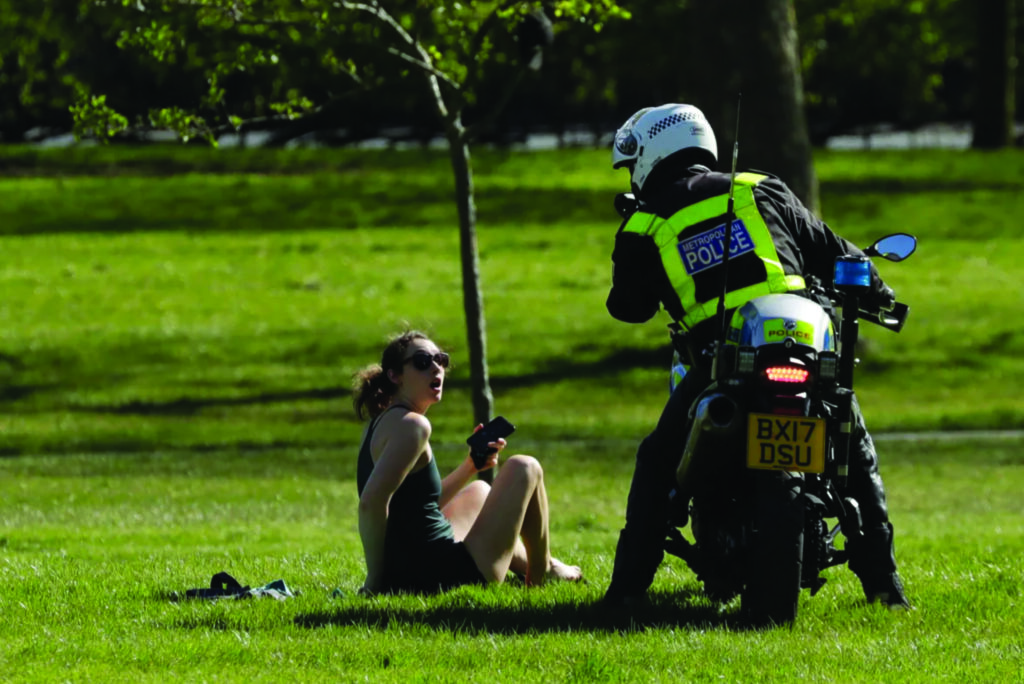
The pandemic has intensified overreach by police in the use of their powers. This is driven by confusion by police as to what their powers actually are as well as macho signalling from their chiefs supporting the use of drones to observe walkers and threatening inspection of shopping to assess if it was ‘bare essentials’. There are well-publicised cases of two women walking in Derbyshire countryside being given fixed-penalty notices (later withdrawn) and police doubling down against a vigil held on Clapham Common, London for the murdered Sarah Everard. At one stage, the Metropolitan Police seemed to be arguing that protests are unlawful. This was wrong.
The effectiveness in preventing the spread of the virus in much of the enforcement that I have dealt with is likely to be minimal – in most cases potentially increasing risk by bringing small numbers into contact with more people through police interaction.[4]
We have also seen concerning enforcement against students by private security companies. In November 2020, I was contacted by an 18-year-old student who was studying at Nottingham Trent University. She had been in another student’s shared accommodation in the floor above her own shared accommodation, in the same block, but numbers had been over six – probably around 10. The police attended, adding to the numbers. The student explained that there was no prohibition on students all congregating in the same laundry room. She said that police had come into the flat and taken her photograph as she was not carrying ID. She said that she had not been asked to return to her flat. She would have done this. Instead, she was issued with a Nottinghamshire police letter indicating that she would be considered for a fixed-penalty notice or prosecution.
Taking responsibility
Currently, government has announced a ‘roadmap’ out of lockdown.[5] However, there remain proposals which represent serious interferences with human rights, such as bans to travel outside the UK without reasonable excuse and the need to produce or share data in order to drink in a pub.
The government and police chiefs need to take responsibility for unlawful and inconsistent issuing of fixed-penalty notices and review them, focusing upon whether they were correctly issued and, where there was evidence of a breach, whether issuing a penalty really was a last resort.
In other words, the discretion not to penalise people for a breach, particularly where there was a low risk of spreading coronavirus, should be applied.
There needs to be a return to policing by consent with enforcement deployed as a last resort. Legal aid cuts should be reversed to enable people to challenge laws which disproportionately interfere with their human rights and to be represented when at risk of criminal sanction.
A new Coronavirus Act II should replace the Coronavirus Act 2020 and the Health Protection Regulations. It should be considered by Parliament through a deliberative process including evidence taking by Parliamentary Committee.
The House of Lords warned in 2008 against ‘fast track’ legislation.[6] Indeed in 2004, the Civil Contingencies Act was passed to provide provision for emergency. At that time, Parliament then carefully considered the constitutional balance between Parliament and Executive in emergency. However, it was jettisoned when there actually was an emergency and the Covid laws were rushed into the space. A new Coronavirus Act would restore Parliament’s spine as well as providing the necessary safeguards to protect the rights of civilians.
More generally, within and beyond government, it is important that there is due respect given to the importance of discussing and highlighting these issues. I have no difficulty in speaking out against the curtailment of civil liberties. But I find that there is increasing polarisation, a desire to place me in a specific group. At the same time, public messaging from the Home Office condemning human-rights lawyers is unhelpful, as well potentially dangerous for all lawyers working in human rights. The government should allow light to shine upon the reasons for the ongoing curtailment of fundamental human rights. After all, the longer freedoms are lost, the deeper they sink and the harder they are to recover.
Kirsty Brimelow QC
Barrister
Kirsty was appointed Queen’s Counsel in 2011. She was the first female Chair of the Bar Human Rights Committee of England and Wales between 2012-2018. She was elected a Bencher of Gray’s Inn in 2016.
Kirsty practises in criminal, international and public law, is a qualified mediator and acts in conflict resolution. In addition to practising in the highest courts at national and international level, Kirsty is an experienced trainer, facilitator and conference speaker in international human rights around the world, holding consultancies to the United Nations and UK Foreign and Commonwealth Office. She is a Visiting Professor in International Law at Goldsmiths University of London.
Kirsty is appointed to panels to advise governments on human rights law. In 2014, she led BHRC’s recommendation of the introduction of female genital mutilation protection orders to the Home Affairs Committee Inquiry. She then advised cross-party parliamentarians on the Bill. In 2020 and 2021 Kirsty gave expert evidence to the House of Lords Constitution Committee and Parliament’s Joint Select Committee on Human Rights on Covid-19 and emergency powers.
In 2020 Kirsty gave the inaugural Heilbron Lecture “Love, Law and Government in the time of Coronavirus”. In 2018 Kirsty won the First 100 Years Inspirational Woman in Law Barrister of the Year Award and the Bar Council’s Advocate’s pro bono International Barrister of the Year Award.
Follow Kirsty on Twitter: @Kirsty_Brimelow
[1] There was only adjustment to align law and guidance towards the end of 2020.
[2] Eweida v United Kingdom (2013) 57 EHRR 9, §79.
[3] Roman Catholic Diocese of Brooklyn v Cuomo 592 US, Supreme Court of the United States, 25 November 2020
The Court granted injunctive relief to prevent enforcement of measures restricting religious services on the basis of a strong challenge founded on First Amendment guarantees of religious liberty: “Not only is there no evidence that the applicants have contributed to the spread of COVID-19 but there are many other less restrictive rules that could be adopted to minimize the risk to those attending religious services.” The Justices accepted (p5) that they were “not public health experts” and that respect was due to the judgment of those with special expertise and responsibility. However, “even in a pandemic, the Constitution cannot be put away and forgotten.”
[4] There is unclear evidence as to whether large gatherings outside increase the spread of the virus.
[5] Imposed in England on 6 January 2021.
[6] House of Lords Select Committee on the Constitution in its report, Fast-Track Legislation: Constitutional Implications and Safeguards (2008–09 HL 116). The Civil Contingencies Act 2004 – brought into force for emergencies and with safeguards at its heart – was rejected by the Government.
More voices on Freedom