


Lockdown and the assault on sociability
The costs of lockdown are always pre-emptively acknowledged in debates about coronavirus. No day goes by without a news segment noting how we, as ‘social creatures’, suffer from the measures imposed, or how friends and families have been ‘painfully’ separated, how ‘difficult’ it has all been, and how this national effort comes with such a great ‘cost’. Conversation in many circles seems to turn in an almost competitive fashion around counting the cost: one person hasn’t seen a friend for several months, another has cancelled a wedding, yet the trump card is played by whoever announces that they haven’t even left the house for a period of time. However, it is as if acknowledging the costs of lockdown has become a way of ignoring them.
This essay is an attempt to not ignore, indeed to illuminate, one cost in particular. In a sea of hard-to-quantify effects, perhaps it is hardest to get a clear sense of the cost of lockdown to sociability. In the first place, it is hard enough to understand of what sociability is. It seems to encompass everything from a pint with friends in a local pub through to bumping into a neighbour in the supermarket, a chance encounter with an old friend on the bus through to a coffee with fellow parents after dropping the kids off at nursery. While the effects of lockdowns on work, education, sport or family life have seen some comment, none of these come close to defining the whole realm of sociability. Though difficult to quantify, the loss of sociability is no less keenly felt.
Given this is all so general, let us briefly try and get a measure of the situation. Take pubs as the most obvious manifestation of British sociability. There are about 47,000 pubs in the UK, and in 2016 the average Brit spent about £350 a year in one.[1] 2020 saw a reduction of about 54 per cent in on-premises beer sales, which could be about 4.3 billion undrunk pints in pubs.[2] Assuming one pint is an hour’s socialising, that’s over 180 million days’ worth of socialising lost.[3] What’s more, the chief exec of the British Beer and Pubs Association estimates about five per cent of pubs closed their doors permanently in 2020 and 72 per cent of those left fear closing permanently, suggesting a legacy of reduced opportunity for socialising for years to come.
Lockdown is hostile to the spontaneity that is essential to sociability.
Now, these kinds of figures are necessarily highly imprecise and wildly detached from the actual experience of sociability (more on this below). They don’t even begin to account for community organisations of all kinds (trades’ clubs, social clubs, ethnic or national organisations, hobby and interest groups, etc), or the socialising that goes on in religious settings, at sports clubs, golf courses, tennis courts and fitness centres, in cafés, at workplaces, or even on the street and in shops. Even if we could get that information, we’d have no way of deciding how to count or measure those hours spent, or how to place a value on them. In other words, artificial exercises such as the one above suggest that, while sociologists or economists will in years to come try and quantify the sociability we have foregone during lockdowns, it is a loss that in principle is impossible to quantify.
Distance between us
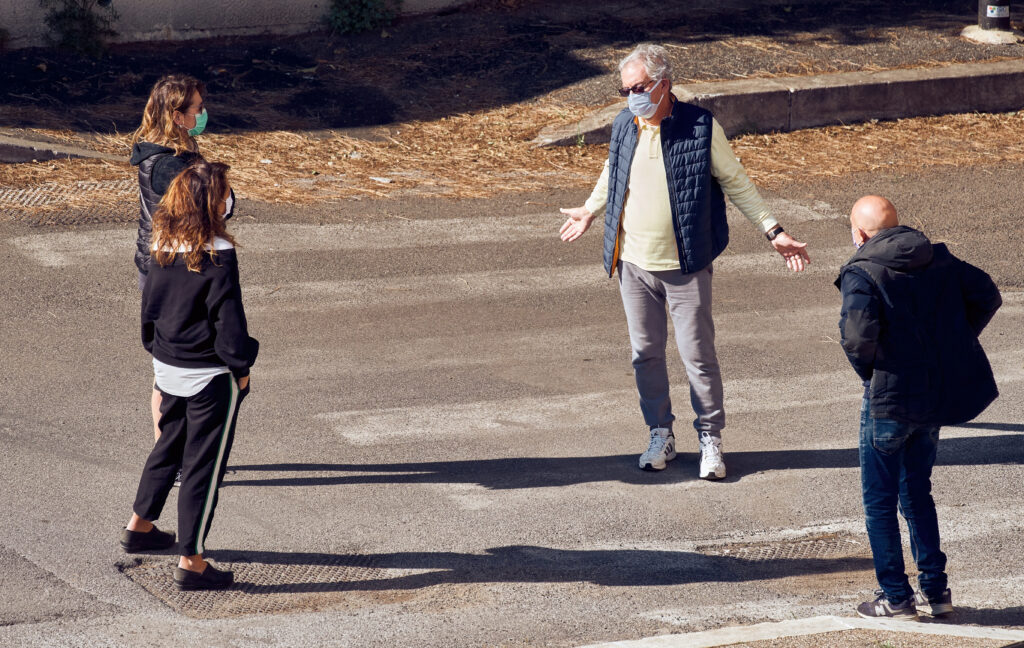
Perhaps, then, we can be more precise by being more general. We can estimate the cumulative effect of lockdown on social life by the phrase which has come to dominate our lives: social distancing. Social life has been distanced from us, we have been distanced from our friends and social groups, and a distance, both physical and emotional, has opened up between us. If on public transport we may briefly appreciate this new-found space between people, there remains something eery about the consciousness of social space that has emerged. The way that everyone gives each other such a wide berth – on the street, in the supermarket, in parks and more – is only the most obvious expression of this new social distance.
Into this new social distance, this void of sociability, have emerged the various virtual spaces which are posed first as a substitute for and then an alternative to real being-with-others. In this sense, the lockdowns accelerated a trend for what Sherry Turkle called being ‘alone together’: the tendency for online spaces to be less a new medium for connecting socially with others and more a veneer of contact that, in the last analysis, makes one more alone than ever. It is as if sharing a photo of your carefully prepared dinner sates just enough of your desire for social contact that you no longer miss the fact you have no one to share it with.
Lifelines for millions
In case this seems too pessimistic, we should note that the proliferation of online groups of all kinds have genuinely functioned, as we often hear, as a ‘lifeline’ to millions around the country. A catalogue of such groups is way outside the scope of this contribution. Perhaps foremost in the public mind have been the quizzes, fitness classes and virtual pubs. Jay’s Virtual Pub Quiz has regular audiences of around half a million people and Jay himself has been thanked by Boris Johnson, landed a spot on national radio, received an MBE, and released a book.
Another such initiative is the ‘Virtual Tavern’ – a wide-ranging online community which began as a pub quiz – which has likewise received accolades including a segment on ITV’s primetime show Ant and Dec’s Saturday Night Takeaway. The Tavern perhaps is more emblematic of the broader sweep of online groups and social events, given its focus on mental health and loneliness over and above entertainment. Indeed, its Twitter bio puts these issues front and centre. In addition to such groups, almost everyone now has a familiarity with Zoom evenings with friends, Facetime choruses of ‘happy birthday’, and the like.
But the existence of these groups should not blind us to what they were set up to provide but a reflection of: social contact. In the same way as food parcels help alleviate the effects of famine, a weekly Zoom call staves off the sense of total isolation. But no one would pretend that occasional food parcels are a viable alternative to a real supply of food. I think one decisive fact about these technological replacements is suggested by the subtitle to Turkle’s book: ‘Why we expect more from technology and less from each other’. Technology is a response to not being able to expect what we need to get from each other.
Turkle’s subtitle is perhaps an allusion to Christopher Lasch’s Culture of Narcissism where he famously laments how ‘we demand too much of life, too little of ourselves’ (the subtitle of the book is again important, referencing as it does ‘diminished expectations’). He goes on to paint a picture of a society beset by a profound spiritual malaise, where the inability to form meaningful social relationships and the reliance on technologies that are but a substitute for social life ‘gives rise to feelings of powerlessness and victimisation’. His description could be a portrait of life in lockdown, and is worth repeating in full:
‘We find it more and more difficult to achieve a sense of continuity, permanence, or connection with the world around us. Relationships with others are notably fragile; goods are made to be used up and discarded [like masks! – JR]; reality is experienced as an unstable environment of flickering images. Everything conspires to encourage escapist solutions to the psychological problems of dependence, separation, and individuation, and to discourage the moral realism that makes it possible for human beings to come to terms with existential constraints on their power and freedom.’
Again, without diminishing the degree to which technology has provided a measure of sociability under lockdown,[4] it is ‘escapist’ to presume it is the same as real sociability.
What is sociability?
But – and to me this is the central question – what is it that is ‘not the same’ about the improvised responses to lockdown? What does real sociability consist in? This question is essential to pose because it is the only sure way to understand what precisely is lost in or threatened by lockdowns. We are at a real disadvantage here, because, as is often the case, the things we have most everyday understanding of are those which are hardest to put our finger on. There is no great philosophical or literary tradition which articulates the meaning of sociability,[5] perhaps because it has never been necessary to do so; you don’t know what you’ve got till it’s gone. Undoubtedly, recent events will prompt some attempt to understand what we mean by this term ‘sociability’. Until such a full accounting can be given, I propose that the central things we should focus on are the twin features of spontaneity and unpredictability.
Sociability is essentially spontaneous in that it resists attempts to prescribe how things will play out, and for this reason also sociability means a large degree of unpredictability. Contrivances and games mark children’s parties off from adult parties precisely because being forced to have fun is a contradiction in terms for adults. Chance encounters feature so strongly in our intuitive sense of what sociability consists in for this reason. It is also why, at least in the Western tradition, alcohol also features so strongly in sociability because of how it breaks down artifice and prompts the unexpected. Sociability has, for this precise reason, been seen as suspect by authoritarian or totalitarian regimes.[6]
Online spaces provide a veneer of contact that makes one more alone than ever.
In this sense, another major trend accelerated by the pandemic has been the tendency towards a fully administered life.[7] Administration is deeply suspicious of spontaneity precisely because of its tendency to be unpredictable. An unpredictable world cannot be known and managed in advance, and so steps must be taken to make it more predictable, more amenable to technological and bureaucratic control. Nobody wants to live in a world where it is completely impossible to plan one’s life, and so some amount of administration is not just necessary but desirable.
But it is hard to resist the conclusion that the logic of lockdown – the reliance on models, data, rules, restrictions and guidance – is not just about introducing a reasonable level of administration in the face of danger, but is, at heart, hostile to spontaneity. The reversal of a presumption of freedom to socialise into the need for a licence to socialise – an expression of a long-running trend of officialdom claiming the power to regulate and license what was previously a presumed freedom – may be one of the most enduring legacies of the pandemic.
Pandemic sociability
That said, we must note that, especially in the first lockdowns, there was a positive, social quality to many efforts to reduce social contact, support those isolating, and otherwise grease the wheels of society under lockdown. Something of an alternate, ‘pandemic sociability’ emerged in the many spontaneous acts of checking in on neighbours, local support groups, donations, volunteering, and even in the over-exaggerated crossings of pavements to avoid one another while out ‘exercising’. Perhaps it would not be a complete contradiction in terms to note that good sociability sometimes requires one to reduce social contact.
Nonetheless, such early, spontaneous attempts at defining a ‘pandemic sociability’ seemed to come to very little in the end. Perhaps the only enduring example was the ‘Clap for Carers’, and even then, the spontaneous social quality of doorstep congregations was soon eclipsed by the increasingly formulaic, contrived form of a half-hearted clap before retreating inside.[8] Indeed, the whole tenor of the official response to the pandemic stacked the cards against anything spontaneous. How likely was something more substantial – a genuine citizen’s effort – when everything has to be risk-assessed, DBS-checked, properly masked, and approved by the local council? Who was likely to take a step out with their neighbours when for months that very neighbour was defined as the source of contagion, danger and even ‘cancelled’?[9] How can we even face the resumption of sociability when the pub has to be booked weeks in advance,[10] everyone checked in with the right app on the right kind of phone,[11] regulars banned from their usual spot propping up the bar?
Return to normal
What, then should we take, for the future? Some hope is given by the fact that the full legacy of lockdown on sociability is still to be defined. The effects on the hospitality industry will leave a scar; a year of missed conversations, hugs, and glances will have knocked our social confidence; the newfound hesitancy around other people will linger on; the suspicion of spontaneity will to some degree be entrenched in regulations and licences.
However, a boisterous ‘return to normal’ – full pubs, street parties, conversations among strangers, spontaneous hugging, more travel, reunion and romance – could well signal a determination to never let the costs of lockdown be imposed again. More than that, perhaps in the coming months and years, armed with a knowledge of what we lost, we find ourselves determined to push back against the very trends that allowed this to happen in the first place.
Jacob Reynolds
Partnerships manager
Jacob is partnerships manager at the Academy of Ideas. He was previously a strategy consultant, specialising in digital transformation and new ways of working.
Jacob read the BPhil in philosophy at St Cross College, Oxford, specialising in political and continental philosophy. He wrote his thesis on Hannah Arendt and liberal political philosophy. He previously read Politics and Philosophy for a BA at the University of Sheffield, where he co-founded the Sheffield Salon, modelled on the Salons of Enlightenment Europe.
He spends his spare time drinking coffee, arguing about philosophy, and writing about literature and politics for various outlets.
Follow Jacob on Twitter: @jacobreynolds
[1] The value of the UK pub market was put at £23.5 Billion in 2016 with a population of about 65.38 Million. See Pubs in danger: Six charts on how the British drink, BBC News, 27 March 2018
https://www.bbc.co.uk/news/business-43492043
[2] As against the over 8 Billion pints sold in 2019. See 255 pints sold per second last year, The Morning Advertiser, 4 March 2020
https://www.morningadvertiser.co.uk/Article/2020/03/04/How-many-pints-were-sold-in-2019
[3] We have to assume that people go to the pub for a reason, and so even if a pint is drunk ‘alone’, it is still social activity, in contrast to drinking at home.
[4] There is a danger we let an assessment of the downsides of lockdown revert into a debate about the merits of online technology. Whatever the merits of such technologies, they are in this case not the result of natural, organic social evolution but instead are forced changes imposed by external circumstance.
[5] Accounts of society, which is not at all the same thing, such as that given by Proust in In Search of Lost Time, are unhelpful and in fact likely to mislead, owing to their stress on artifice and role-playing.
[6] On the destructive but futile attempts to eradicate spontaneous sociability in the Soviet Union, see especially Second Hand Time, by Svetlana Alexievich, trans. Bela Shayevich (Fitzcarraldo Editions, 2016)
[7] Worries about the ‘administered life’ are, with unrelenting pessimism, expressed comprehensively for the first time in Dialectic of Enlightenment, by Theodore Adorno and Max Horkheimer, trans. John Cumming (Verso, 1997)
[8] This is not to be curmudgeonly: the ‘clap’ was only ever supposed to be a gesture, and being co-opted by the government was not likely to preserve its spontaneous quality.
[9] ‘Our neighbour has been cancelled and it is curious that churches remain silent on the subject. What do human relationships become in a country that habituates itself to live in this way for who knows how long?’
See Giorgio Agamben: “Clarifications”, An und für sich, 17 March 2020
https://itself.blog/2020/03/17/giorgio-agamben-clarifications/?fbclid=IwAR3y8hIOkUIFgxfITZ4qVxNmhLyHfa2y7QE2rm7dJOLNPpWVNkEjrfFiMr4
[10] Even The Guardian had to make room for a remark on the absurdly bureaucratic procedure of going to the pub. See ‘As England enters a world of pre-booked fun, spare a thought for the disorganised’, The Guardian, 13 April 2021
https://theguardian.com/commentisfree/2021/apr/13/coronavirus-pre-booked-fun-pubs-disorganised
[11] When pensioners are refused a pint because they don’t have a smartphone app, you know that Britain truly specialises in the banality of evil. See Older drinkers risk discrimination says charity, after pub refuses to serve man without smartphone, The Telegraph, 13 April 2021
https://www.telegraph.co.uk/news/2021/04/13/older-drinkers-risk-discrimination-says-charity-pub-refuses/
More voices on Cultural life


Lockdown: closing the door on culture


Sport matters and sport needs crowds

